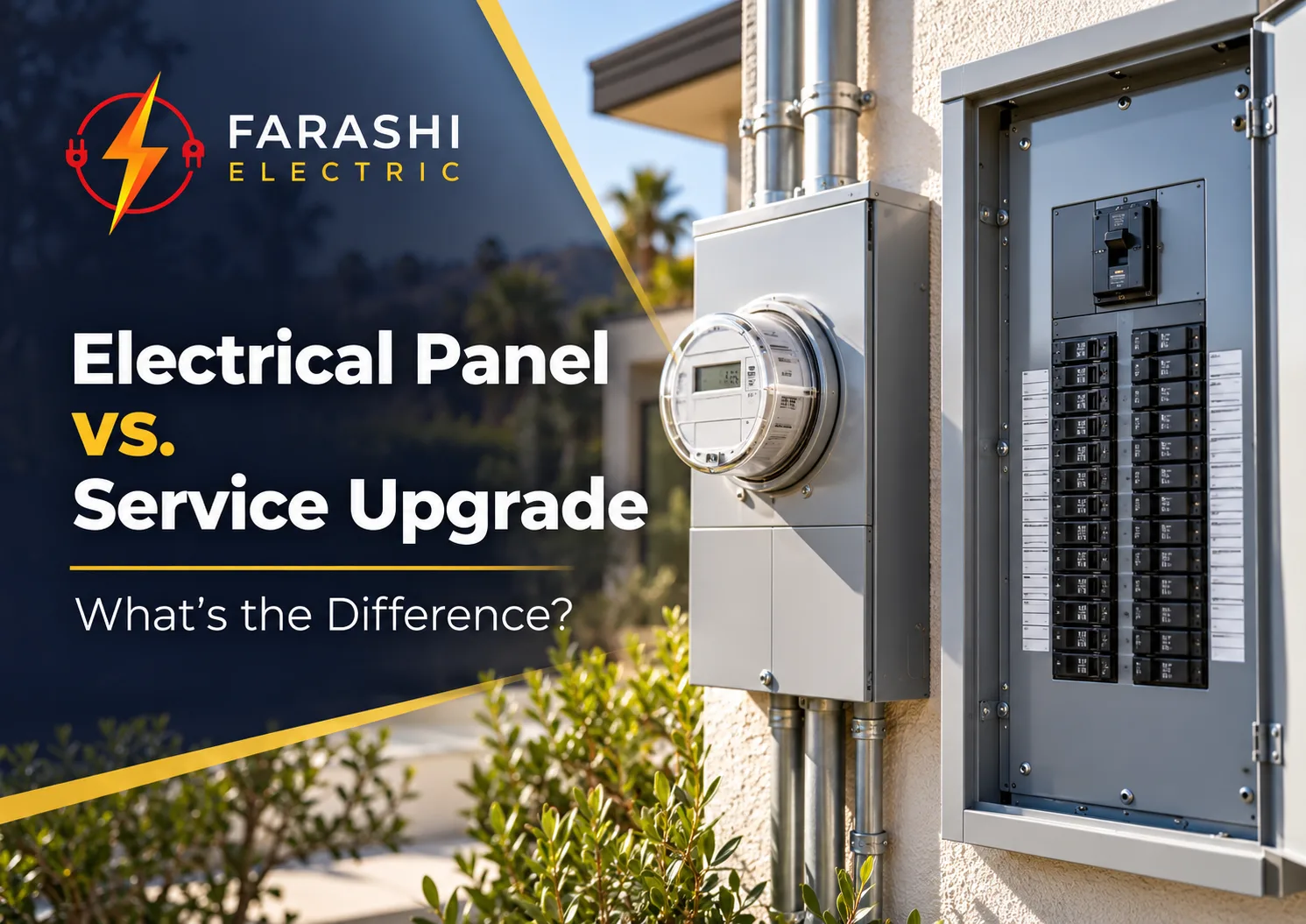
Electrical Panel vs. Service Upgrade: What’s the Difference?
An electrician tells you that your home needs a “panel upgrade.” But does that mean your house is actually getting more electrical capacity? Not necessarily.
Replacing an electrical panel can simply mean installing new distribution equipment while keeping the same service amperage. A true electrical service upgrade increases the capacity available to the home and may involve the meter equipment, service conductors, main disconnect, panel, and utility connection.
Understanding that distinction can help you compare estimates, plan for EV charging or other new loads, and avoid paying for a larger project when a smaller one will solve the problem.
Jump to Section
ToggleQuick Answer
Here is the simplest way to separate the terms:
- Panel replacement: The existing breaker panel is replaced. The home’s service capacity may remain exactly the same.
- Panel upgrade: An informal term that can mean several things, from replacing an old panel to installing larger equipment or increasing service capacity.
- Service upgrade: The home’s electrical service capacity is increased, such as changing from 100 amps to 200 amps.

Electrical Panel vs. Service Upgrade: The Main Difference
An electrical panel distributes electricity to the circuits throughout your home. The electrical service determines how electricity is supplied to the home and how much capacity the service is designed to provide.
That means a panel project and a service project can overlap, but they are not automatically the same job.
For example:
100A old panel → 100A new panel
This may be a panel replacement with no increase in service capacity.
By comparison:
100A service → 200A service
This is a service-capacity increase. Depending on the existing installation, additional equipment may also need to change.
The distinction becomes especially important when comparing contractor estimates because two proposals both described as a “panel upgrade” may include very different work.
What Does It Mean to Upgrade Electrical Service?
An electrical service upgrade generally means increasing the capacity of the electrical service supplying the property.
A common example is an upgrade from 100 amps to 200 amps.
Depending on the existing installation, that project may involve some combination of:
- Main service equipment
- Main breaker or service disconnect
- Meter socket or meter-main equipment
- Service entrance conductors
- Grounding and bonding components
- Overhead service equipment
- Underground service equipment
- Utility coordination
- Electrical panel
The exact scope is property-specific.
This is why installing a larger breaker panel alone does not necessarily increase the home’s electrical service capacity. The equipment feeding that panel must also be suitable for the proposed service rating.
Panel Replacement vs. Panel Upgrade
“Panel replacement” is relatively clear: the existing panel is being replaced.
“Panel upgrade” is much less precise.
Depending on the contractor or project, it might mean:
- Replacing an old panel with modern equipment
- Installing a panel with additional breaker spaces
- Installing equipment with a higher bus rating
- Relocating the panel
- Changing a meter-main arrangement
- Increasing the electrical service capacity
- Some combination of these
For that reason, homeowners should not rely on the term “panel upgrade” alone when comparing estimates.
Ask what the project actually changes.
If you are planning to upgrade your electrical panel, the proposal should identify the existing service size, proposed equipment, whether the service amperage changes, and whether meter or utility work is included.
Not Sure If You Need a Panel or Service Upgrade?
Farashi Electric helps Los Angeles homeowners evaluate panel conditions, electrical service capacity, and future power needs before recommending an upgrade.
Request a Free EstimateWhen Do You Actually Need a Service Upgrade?
A service upgrade should be considered when the existing electrical service cannot appropriately support the home’s calculated electrical demand or planned additions.
For example, suppose a homeowner with an existing 100A service wants to add a Level 2 EV charger, electric HVAC equipment and another major appliance.
The electrician should not immediately jump from “100A” to “you need 200A.”
The existing loads and proposed equipment should first be evaluated.
That assessment may show that a service-capacity increase is appropriate. In another home, the existing system may have enough available capacity, or a different design approach may be possible.
This is particularly important when evaluating panel capacity for an EV charger. A new EV charger does not automatically require a complete service upgrade.
Before spending money on a larger service, determine what the actual load requires.
Panel Space Is Not the Same as Service Capacity
This is one of the most important distinctions for homeowners to understand.
A panel may have several empty breaker spaces and still have limited capacity for a large new electrical load.
The reverse can also happen: a panel may be physically full even though the electrical service still has adequate capacity.
Several different concepts are involved:
Breaker spaces
These tell you how many circuit positions the panel provides.
Panel bus rating
This is an equipment rating of the panel’s internal bus structure.
Main breaker rating
This indicates the rating of the service or feeder overcurrent device associated with that equipment.
Service rating
This relates to the electrical service supplying the property and the equipment that forms that service.
Calculated electrical load
This evaluates the loads the electrical system is expected to serve under the applicable calculation method.
These numbers should not be treated as interchangeable.
For example, putting a panel with a 200A bus on a home does not automatically turn the home into a 200A service.
Likewise, finding two unused breaker positions does not prove that a new 40A, 50A or 60A load can simply be added.

Three Real-World Examples
Scenario 1: Old 100A Panel, But No Major New Loads
A homeowner has an older 100A service. The existing panel needs replacement, but the household primarily uses gas appliances and is not planning significant new electrical loads.
If the service capacity remains appropriate and the existing service equipment is suitable, replacing the panel without increasing the service to 200A may be reasonable.
The equipment changes. The service capacity stays the same.
Scenario 2: EV Charger and Major Electrification
Another home has 100A service and the owner wants to add an EV charger, electric HVAC and other substantial electrical loads.
This does not automatically prove that a 200A service is required.
But it does make a proper load evaluation important.
If the calculated demand and future plans exceed what the existing service can appropriately support, then a full service upgrade may become the correct solution.
Scenario 3: No Breaker Space, But Adequate Service Capacity
A third homeowner wants to add several circuits, but the existing panel has no practical breaker spaces remaining.
That is a distribution-space problem.
If the home’s electrical service still has adequate capacity, the appropriate solution might involve a larger panel, a properly designed subpanel or another configuration rather than increasing the service amperage.
More breaker space and more electrical capacity are not the same thing.
How an Electrician Determines What You Need
A good evaluation should start with the existing system and the homeowner’s actual plans.
A practical process includes:
- Identify the existing service rating.
- Inspect the condition and configuration of the panel.
- Review the meter and service equipment where relevant.
- Identify existing major electrical loads.
- Review planned additions such as EV charging, HVAC or remodeling.
- Perform an appropriate load calculation when needed.
- Check available panel space and equipment ratings.
- Determine whether the problem is equipment condition, distribution space, electrical capacity or a combination of them.
Only after those questions are answered does it make sense to choose between repair, panel replacement, additional distribution equipment or a complete service upgrade.
For Los Angeles homeowners, Farashi Electric can evaluate the panel, service equipment, existing load and planned additions before recommending a larger project.
Electrical Panel vs. Service Upgrade Cost
A service upgrade normally involves more variables than a straightforward panel replacement, which is one reason the two projects can have very different prices.
The cost depends on the actual scope, including factors such as:
- Existing service amperage
- Proposed service amperage
- Panel and service-equipment configuration
- Meter location
- Overhead versus underground service
- Existing service conductors
- Utility work or coordination
- Grounding and bonding work
- Permit and inspection requirements
- Accessibility
- Equipment relocation
- Trenching or other site work
- Necessary corrections associated with the project
This also explains why comparing estimates based only on the final price can be misleading.
One contractor may be quoting a panel-only replacement while another is quoting a complete service change. Before comparing numbers, compare scopes.
Los Angeles Considerations
For projects within the City of Los Angeles, electrical work is subject to LADBS permitting and inspection requirements.
A service project may also require coordination with LADWP when electrical loads, meters or service equipment are being installed, upgraded, relocated or modified.
The current equipment requirements and project process should be confirmed for the particular property because overhead and underground services, meter arrangements, property conditions and project scope can affect what is required.
Requirements can also differ outside the City of Los Angeles, even when the property is elsewhere in Los Angeles County.
That is why the main breaker and meter-main setup should be evaluated as part of the actual property rather than selected from a generic online recommendation.
Bahram Farashi
C-10 Licensed Electrician (CA Lic. #1102687) — 10+ years installing residential/commercial Electrical Services.
Frequently Asked Questions
No. Replacing a panel changes the distribution equipment, but the home’s service amperage can remain the same. A service upgrade increases or changes the service capacity and may involve additional service equipment.
Not automatically. A panel can have a 200A equipment rating while the service supplying it is configured or limited differently. The service conductors, disconnecting equipment, meter arrangement and overall service must be evaluated.
Yes, when the existing 100A service remains suitable for the home’s load and the other service equipment is acceptable for the project.
Start by determining why the project is needed. Panel condition, existing service size, equipment ratings, available breaker space, current loads and future electrical additions should all be evaluated before the scope is selected.