
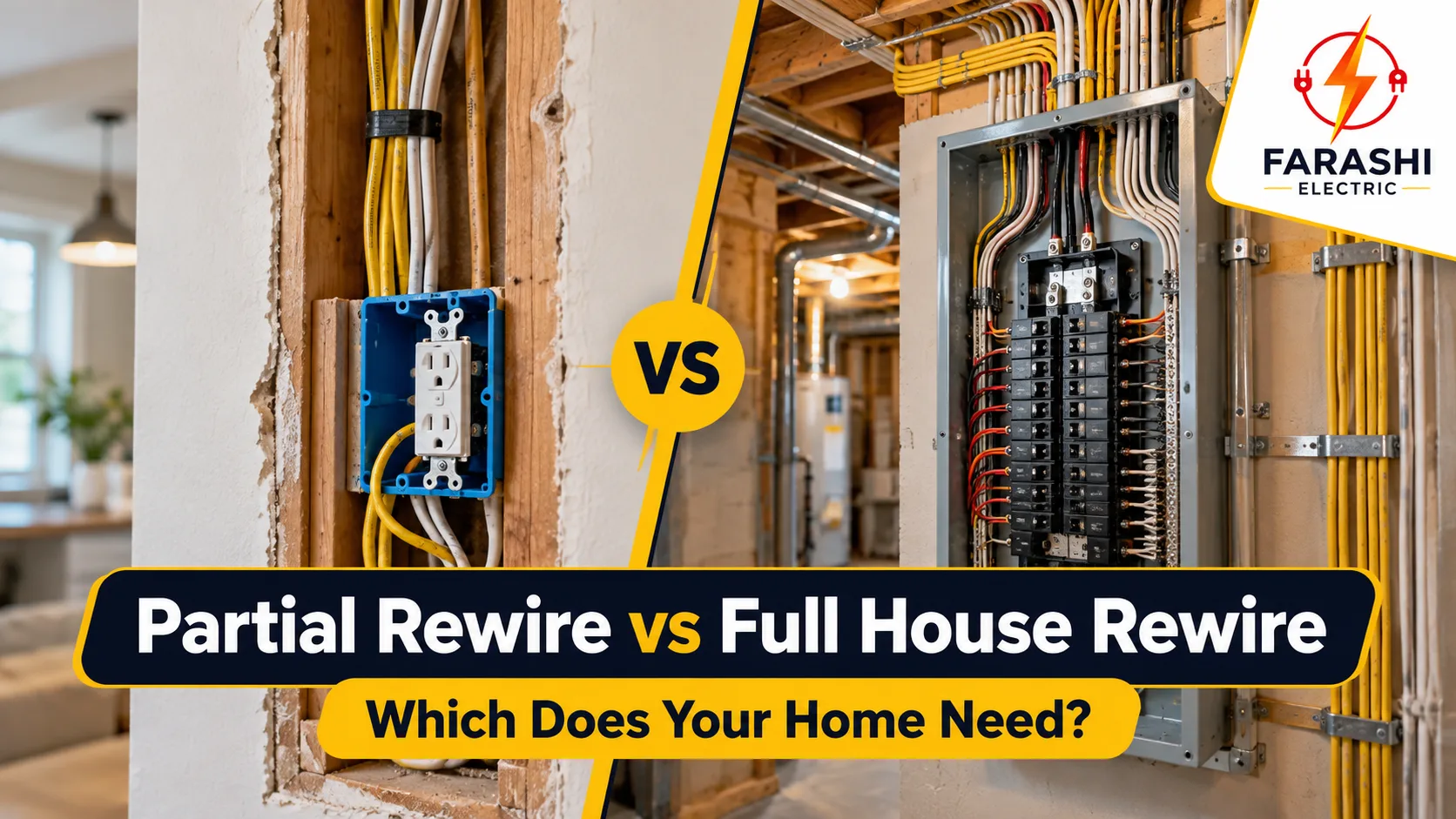
Partial Rewire vs Full House Rewire: Which Does Your Home Need?
Finding old or damaged wiring in one part of your house does not automatically mean every circuit needs to be replaced. On the other hand, repairing one area at a time can become expensive and disruptive when the electrical problems are spread throughout the home.
The right choice between a partial rewire and a full house rewire depends mainly on the condition, extent, and layout of the existing electrical system, not simply the age of the house.
Jump to Section
ToggleQuick Answer
A partial rewire usually makes sense when the problem is limited to specific rooms, circuits, or damaged sections and the remaining wiring is still in acceptable condition.
A full house rewire becomes more practical when deterioration, unsafe alterations, inadequate grounding, or repeated problems affect a large portion of the electrical system.
The decision should be based on an electrical evaluation, not assumptions about the age of the home.

What Does a Partial Rewire Mean?
A partial rewire means replacing or upgrading wiring in selected areas while leaving suitable existing wiring in service elsewhere.
Examples include:
- rewiring a kitchen during a remodel;
- replacing one damaged branch circuit;
- upgrading wiring in an addition;
- installing new grounded circuits in selected rooms;
- replacing deteriorated wiring in one accessible section of a home;
- correcting unsafe modifications affecting only a few circuits.
A partial rewire is not simply replacing the easiest wire to reach. The electrician should also determine whether the retained portions of the electrical system can continue operating safely with the new work.
What Is a Full House Rewire?
A full house rewire generally means replacing most or all of the branch-circuit wiring throughout the home.
Depending on the property, the work may also include new circuits, receptacles, switches, boxes, grounding improvements, dedicated appliance circuits, and changes at the electrical panel.
The exact scope varies. “Full rewire” should therefore be clearly defined in an estimate rather than treated as one universal package.
Partial Rewire vs Full House Rewire: Key Differences
Factor | Partial Rewire | Full House Rewire |
Scope | Selected circuits or areas | Most or all branch wiring |
Best suited for | Localized problems | Widespread problems |
Initial cost | Usually lower | Usually higher |
Disruption | Typically more limited | Affects more areas |
Wall access | Limited where possible | Usually more extensive |
Existing wiring | Some remains | Most is replaced |
Long-term value | Strong when remaining wiring is sound | Often stronger when many circuits already need work |
The important distinction is not simply how much wire gets replaced. It is whether the electrical problems are genuinely localized or part of a larger pattern.
Can You Rewire Only Part of a House?
Yes. Rewiring only part of a house can be entirely reasonable when the affected circuits are clearly identified and the remaining system is suitable to stay in service.
New and older wiring can sometimes remain in the same home. What matters is whether the existing conductors, connections, grounding, protection, and transition points are appropriate for the installation.
A partial rewire becomes less attractive when the electrician keeps discovering deterioration or questionable modifications beyond the original work area.
Before choosing the smaller project simply because it costs less initially, it is worth evaluating the condition of the wiring that will remain.
Not Sure If Your Home Needs Partial or Full Rewiring?
Farashi Electric helps Los Angeles homeowners evaluate existing wiring, identify electrical problems, and determine whether targeted repairs or broader rewiring make sense.
Request a Free EstimateWhen Is a Partial Rewire Enough?
Partial house rewiring often makes sense when:
- one circuit has suffered localized damage;
- a kitchen or bathroom is being remodeled;
- a small group of circuits is outdated while the rest of the system is acceptable;
- new dedicated circuits are being added;
- wiring in one section has deteriorated because of a specific event;
- walls are already open in one area during construction;
- the remaining electrical system has no evidence of widespread deterioration.
One failed receptacle or damaged circuit does not justify replacing every wire in the building.
The electrician should still investigate why the failure occurred. A damaged conductor caused by one localized event is very different from overheating caused by broader circuit-loading or connection problems.
When Does a Full House Rewire Make More Sense?
A full rewire becomes more reasonable when the defects extend well beyond one room or circuit.
Examples include:
- deteriorated insulation found in multiple areas;
- repeated electrical failures across different circuits;
- extensive ungrounded wiring combined with other deficiencies;
- numerous undocumented or poorly executed modifications;
- evidence of overheating in several locations;
- major renovation that already exposes much of the wiring;
- a circuit layout that no longer works well for the way the home is used;
- several upcoming partial rewiring projects that would duplicate labor and wall access.
A full rewire should not be recommended just because the house is old.
Many older homes have sections of wiring that remain serviceable, while some newer installations can have problems because of damage, improper modifications, or poor workmanship.
Does My House Need Rewiring?
Certain symptoms justify professional evaluation, but they do not automatically mean the home needs a full rewire.
Examples include frequent breaker trips, flickering lights, buzzing devices, warm or discolored outlets, damaged insulation, burning odors, or repeated circuit failures.
One localized problem may lead to repair damaged circuits rather than whole house rewiring.
A pattern affecting several rooms is more significant, especially when combined with deteriorated conductors, inadequate grounding, overheating, or extensive previous modifications.

How an Electrician Decides Between Partial and Full Rewiring
A meaningful evaluation goes beyond looking at the age of the house.
An electrician may consider:
The type and condition of existing wiring and insulation.
Whether grounding and bonding are adequate.
How many circuits are affected and whether problems are isolated or widespread.
Signs of overheating, damaged connections, or overloaded circuits.
Previous electrical modifications and repairs.
Available attic, crawlspace, or wall access.
Planned remodeling and future electrical needs.
Whether the existing panel can support any additional circuits.
Whether repeated partial repairs would increase long-term costs.
Rewiring does not automatically require a panel upgrade. However, limited breaker space, damaged equipment, or insufficient capacity may affect the project scope.
Farashi Electric can help Los Angeles homeowners determine whether a wiring problem appears limited to a particular circuit or is part of a wider condition before choosing the scope of the project.
Partial Rewire Cost vs Full Rewire Cost
A partial rewire is usually less expensive initially because fewer circuits and areas are involved.
However, price depends heavily on access and scope.
Important cost factors include:
- number and length of circuits;
- attic or crawlspace access;
- finished versus open walls;
- plaster, drywall, or other construction;
- number of receptacles, switches, and lighting points;
- panel condition;
- required permits and inspections;
- occupied versus vacant conditions;
- wiring routes;
- patching or finish work;
- whether several separate projects could be combined.
This is why a generic price per square foot can be misleading.
The better question is whether the wiring being left behind is likely to remain serviceable. Several partial projects completed separately can sometimes cost more than addressing the broader problem during one coordinated project.
Can Rewiring Be Done Without Major Wall Damage?
Sometimes, but not always.
Electricians may be able to use attic or crawlspace access, existing wiring paths, unfinished areas, closets, or carefully selected openings to fish new cable through finished walls.
Homes with difficult framing, fire blocking, inaccessible ceilings, or limited attic and crawlspace access may require more openings.
Rewiring without major wall damage is often possible, but promising absolutely no wall damage before evaluating the building would be unrealistic.
Homeowners concerned about finishes should discuss rewiring without major wall damage before the scope is finalized.
Bahram Farashi
C-10 Licensed Electrician (CA Lic. #1102687) — 10+ years installing residential/commercial Electrical Services.
FAQ
A partial rewire replaces wiring in selected circuits, rooms, or sections while suitable existing wiring remains in service elsewhere.
Yes. It can be a practical solution when the problem is isolated and the remaining wiring is in acceptable condition.
There is no reliable flat price because the number of circuits, wiring routes, access, wall construction, panel work, permits, and restoration requirements can vary significantly.
A full rewire becomes more reasonable when deterioration, unsafe modifications, grounding problems, or recurring failures affect many circuits rather than one isolated area.
Yes, in some circumstances. Existing wiring does not automatically need replacement simply because new circuits are being installed elsewhere. Its condition and suitability should be evaluated before it is retained.