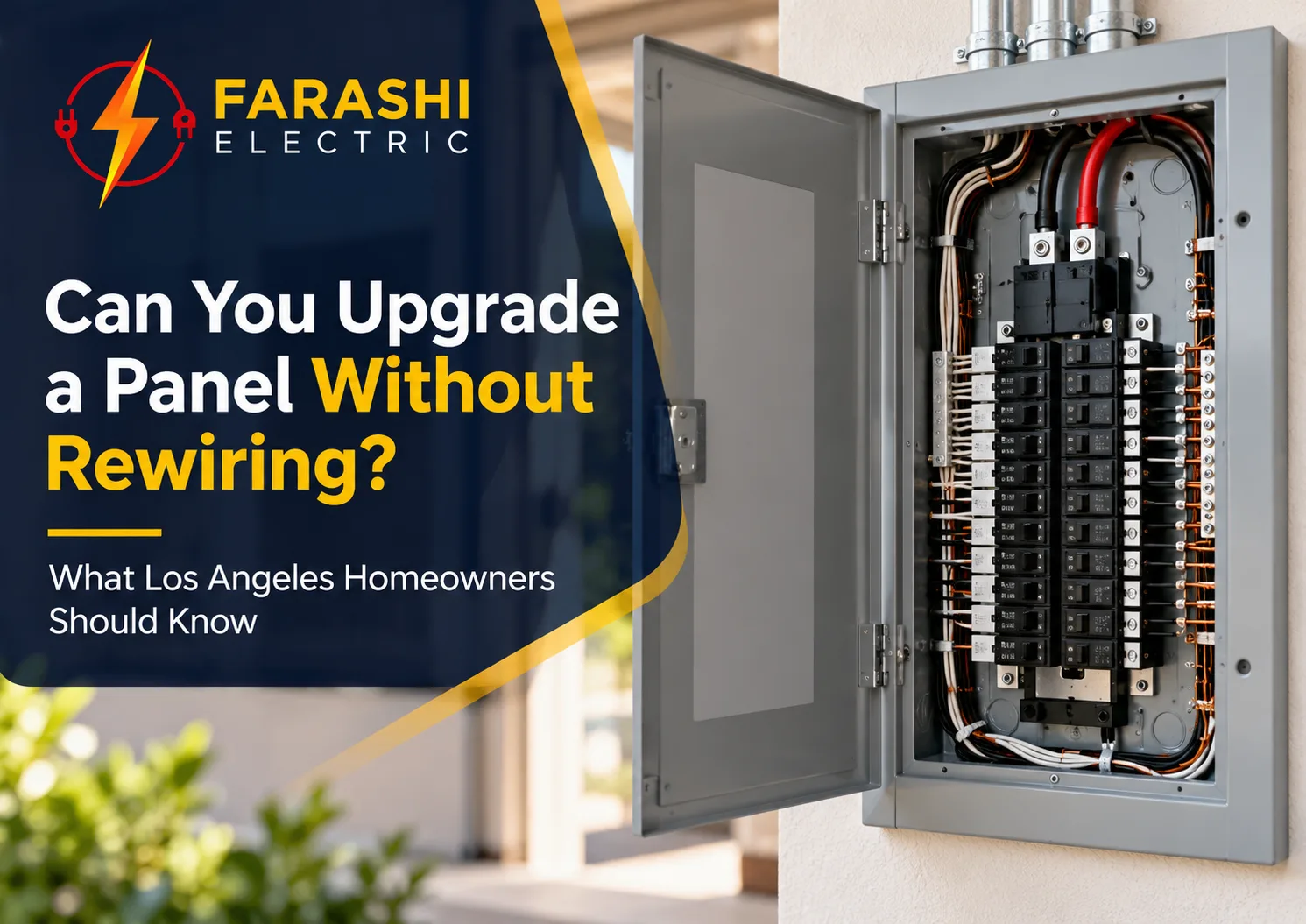
Can You Upgrade an Electrical Panel Without Rewiring the House?
Replacing an outdated electrical panel doesn’t necessarily mean replacing the wiring throughout your home. In many cases, existing circuits can remain connected to a new panel, avoiding unnecessary wall openings, additional labor, and rewiring costs.
The deciding factor isn’t simply how old your home is. It’s whether the existing wiring is in suitable condition, properly protected, and compatible with the replacement equipment.
Quick Answer: Yes, you can often upgrade or replace an electrical panel without rewiring the entire house. However, damaged conductors, improper connections, or unsuitable circuits may require repairs or partial rewiring. Increasing electrical service capacity also doesn’t automatically mean replacing the wiring inside your walls.
Jump to Section
ToggleWhen Can You Upgrade a Panel Without Rewiring?
An electrical panel distributes power to individual circuits throughout your home. Those circuits supply electricity to outlets, lighting, and appliances.
When a panel is replaced, the existing branch circuits can often be disconnected from the old equipment and reconnected to the new panel.
This is generally possible when:
- Existing conductors are in acceptable condition.
- Wire sizes are appropriate for their circuit breakers.
- Connections and terminations can be made properly.
- Grounding and neutral arrangements are suitable or can be corrected.
- The circuits have no identified damage requiring replacement.
- The wiring is suitable for continued use under the applicable project requirements.
An important distinction: Reusing existing wiring doesn’t mean an electrician has verified every inch of wire concealed inside the walls. The evaluation should account for the accessible conditions, known problems, and any additional investigation the project requires.
If you’re considering an electrical panel upgrade in Los Angeles homeowners can benefit from having both the panel and accessible wiring evaluated before approving the scope of work.

What Happens to Existing Wiring During Panel Replacement?
During a typical replacement, the electrician disconnects existing circuits, removes the old equipment, installs the replacement panel, and reconnects suitable conductors to appropriately rated breakers.
Before reconnecting them, the electrician may examine several important details:
- Conductor condition: Signs of overheating, corrosion, damaged insulation, or previous repairs.
- Wire size and breaker rating: Whether each circuit has appropriate overcurrent protection.
- Connections: Loose, doubled-up, or otherwise improper terminations.
- Neutrals and grounding: Whether conductors are identified and connected appropriately for the panel’s location and function.
- Circuit identification: Whether existing circuits can be correctly identified and labeled.
- Breaker compatibility: Whether the selected breakers are listed or otherwise approved for the replacement panel.
Sometimes existing conductors are too short to reach their new termination points. Approved extensions or splices may be possible without replacing the entire circuit.
However, if a panel is relocated, additional wiring work may be needed to reach the new location. That still doesn’t necessarily mean rewiring every room.
When Might Additional Rewiring Be Necessary?
A panel replacement can reveal existing wiring problems that require attention before affected circuits are reconnected.
Common examples include:
- Damaged or overheated conductors
Heat-damaged insulation or conductors near the old panel may require repair or replacement. The electrician should determine whether damage is limited to the accessible ends or extends farther along the circuit.
- Incorrect wire sizes or circuit protection
A conductor must be properly protected for its permitted use. Installing a larger breaker simply because the new panel supports it can create an unsafe condition.
- Improper previous modifications
Unsafe splices, incorrect terminations, or poorly installed circuit extensions may need correction. Depending on the condition, the repair could involve only a small section of wiring.
- Older or unusual wiring systems
Older homes may contain ungrounded wiring, aluminum branch circuits, or other legacy installations. These conditions require appropriate evaluation, but their presence alone does not establish that every circuit must be replaced.
- Widespread wiring deterioration
If multiple circuits show significant damage, deteriorated insulation, or recurring faults, broader rewiring may be justified.
The important distinction is between an isolated problem and a system-wide condition.
A single damaged branch circuit may require only a targeted repair. More extensive problems could justify partial rewiring or, in some cases, full house rewiring.
The choice between a partial rewire vs full house rewire should be based on the actual condition and extent of the problems, not simply the age of the property.
Need a Panel Upgrade Without Unnecessary Rewiring?
Farashi Electric helps Los Angeles homeowners assess their panels and existing wiring to determine what needs replacing and what can safely stay.
Request a Free EstimateDoes Upgrading From 100 Amps to 200 Amps Require Rewiring?
No. Upgrading electrical service from 100 amps to 200 amps does not automatically require replacing every existing branch circuit.
A 200-amp service provides greater capacity at the service level, subject to the equipment design and approved installation. It does not increase the current-carrying capacity of existing wiring.
For example:
- An existing 15-amp lighting circuit generally remains a 15-amp circuit.
- An existing 20-amp receptacle circuit generally remains a 20-amp circuit.
- A new EV charger may require a separate circuit with properly sized conductors and protection.
The difference between a 100 amp vs 200 amp panel is therefore not simply whether all household wiring can carry more electricity.
A service-capacity increase may require changes to the meter equipment, service conductors, main disconnect, grounding and bonding, and utility connections.
These components must be evaluated separately from the wiring serving individual rooms.
Panel Replacement vs. Service Upgrade vs. House Rewiring
These terms are related, but they describe different types of electrical work.
Project | What Changes | Does It Require Whole-House Rewiring? |
Panel replacement | Existing panel is replaced, sometimes at the same amperage | Not automatically |
Panel upgrade | Panel equipment, breaker capacity, or available circuit space may change | Not automatically |
Service upgrade | Electrical service capacity increases, such as 100A to 200A | Not automatically |
Partial rewiring | Wiring on selected circuits or in specific areas is replaced | Only affected areas |
Full house rewiring | Branch-circuit wiring throughout the home is substantially replaced | Yes, by definition |
A panel replacement and service upgrade may happen together, but they are not interchangeable.
Likewise, a larger panel with additional breaker spaces does not necessarily mean the home’s electrical service amperage has increased. A subpanel can sometimes add circuit spaces without increasing service capacity, provided the electrical system can support the installation.
Understanding panel upgrade vs service upgrade helps homeowners compare contractor estimates that might otherwise describe very different projects using similar terminology.

Can You Upgrade a Panel Without Rewiring in California?
Yes. An electrical panel can often be replaced or upgraded in California without rewiring the entire house, provided existing circuits are suitable for continued service and the work meets applicable requirements.
For projects governed by the 2025 California Electrical Code, which became effective January 1, 2026, the actual work performed and applicable local requirements determine what must be addressed.
Within the City of Los Angeles, electrical panel work requires appropriate permitting and inspection through the Los Angeles Department of Building and Safety (LADBS).
A service upgrade may also involve coordination with the Los Angeles Department of Water and Power (LADWP), particularly when meter equipment, service capacity, or utility connections change.
Requirements can differ in neighboring cities and other jurisdictions.
Does the Whole House Have to Meet Current Code?
Replacing a panel does not generally mean that every existing outlet, switch, and concealed cable must automatically be replaced to match current new-construction standards.
However, the permitted installation must satisfy applicable requirements. These may involve new equipment, grounding and bonding, circuit protection, or corrections related to the work being performed.
Existing unsafe conditions discovered during the project may also require attention.
For that reason, an electrician should identify which improvements are required for the permitted work, which correct identified safety problems, and which are optional recommendations.
How Does an Electrician Determine Whether Wiring Can Stay?
The decision should be based on the actual electrical installation rather than a blanket recommendation to rewire an older home.
A practical assessment generally includes:
- Reviewing the panel and service: Identify equipment ratings, condition, existing configuration, and the proposed scope.
- Inspecting accessible wiring: Examine conductor insulation, terminations, and signs of damage.
- Checking circuit protection: Confirm appropriate conductor sizing and breaker selection.
- Evaluating grounding and bonding: Identify existing arrangements and necessary corrections.
- Reviewing previous modifications: Check for improper connections, splices, or unidentified circuits.
- Considering existing and future loads: Determine whether proposed appliances or EV charging require new circuits or additional capacity.
- Determining the repair scope: Separate panel work from limited wiring corrections, partial rewiring, or broader replacement.
Additional testing or investigation may be appropriate if circuit faults, questionable wiring, or inaccessible conditions create uncertainty.
Farashi Electric helps Los Angeles homeowners evaluate these factors and distinguish between panel replacement, service upgrades, circuit repairs, and rewiring before recommending the appropriate work.
Bahram Farashi
C-10 Licensed Electrician (CA Lic. #1102687) — 10+ years installing residential/commercial Electrical Services.
Frequently Asked Questions
Yes. Older wiring may remain connected if it is suitable for continued use, can be properly terminated and protected, and meets applicable project requirements. Age alone does not determine whether replacement is necessary.
Often, yes. If damage is limited to certain conductors or circuits, targeted repairs or partial rewiring may be appropriate. The electrician must determine the extent of the problem.
No. A 200-amp service does not change the allowable capacity of individual branch circuits. Their wiring, circuit protection, and intended loads still determine how much current they can safely carry.
Sometimes improvements such as adding a properly sized subpanel or using manufacturer-approved breaker configurations can provide additional circuit spaces. However, these changes do not automatically increase service capacity, and a damaged or unsuitable panel may require replacement.